The Customer Acquisition Playbook for Early-Stage SaaS
The low-cost, high-impact acquisition strategies that transformed bootstrapped startups into billion-dollar platforms
The Customer Acquisition Playbook for Early-Stage SaaS
It's 2011, and Eric Yuan is pitching Zoom to every VC in Silicon Valley. Meeting after meeting, he hears the same thing: the video conferencing market is saturated. Cisco owns enterprise. Skype dominates consumer. Forty-one rejections later, Yuan had to grow Zoom without venture-backed acquisition budgets.
Zoom's market cap eventually peaked at over $160 billion, built not on advertising spend, but on a product that spread through use. Every meeting Zoom users scheduled introduced non-users to the product. The secret wasn't money. It was that joining a meeting required no account, no download, no friction at all.
The companies that crack early acquisition without big budgets aren't just lucky. They engineer their product so growth happens through usage.
Acquisition economics
Traditional marketing assumes acquisition requires upfront spend. Early-stage SaaS companies that scale without large budgets flip that equation, they build acquisition into the product itself, so customers bring in other customers.
Consider Loom. They didn't outspend Camtasia or ScreenFlow. They built screen recording so that every video created became a distribution channel. When someone shared a Loom video, the recipient experienced the product before signing up. Demand came through product demonstration, not marketing.
The companies that scale fastest track a different metric: not just cost-per-acquisition, but how effectively each customer generates additional customers. When your user base is your best sales channel, the math changes.
Product-led growth
Product-led growth isn't just freemium or free trials. It's designing the product experience to be inherently shareable from the first interaction.
Zoom's breakthrough wasn't superior video quality. It was frictionless joining. While competitors required downloads, plugins, and account creation, Zoom eliminated every barrier between invitation and participation. That decision meant every meeting was a product demonstration for non-users.
When your product reduces friction for existing users while showing value to potential users at the same time, you create loops where customer success drives customer acquisition.
Canva didn't beat Adobe by having more features. They inverted the adoption curve. Instead of requiring users to learn complex tools before getting value, Canva delivered immediate results through templates and drag-and-drop. By the time users hit usage limits, they were already attached to what the platform had helped them create.
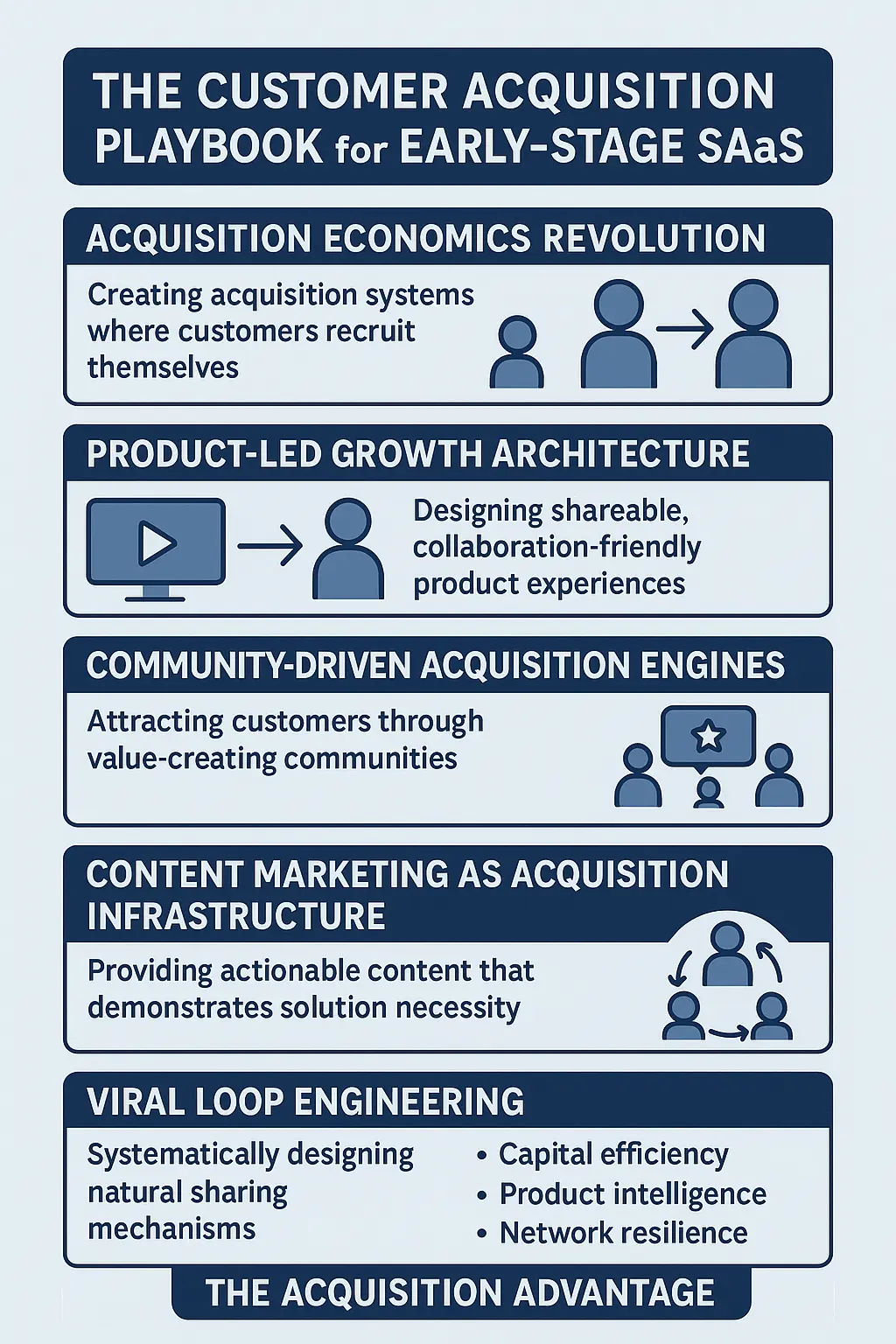
Community-driven acquisition
The most sustainable acquisition channels don't interrupt potential customers, they draw them in through genuine value.
Instead of content marketing that promotes your product, build educational resources where you become the go-to reference for your domain. This shifts your brand from vendor to authority. When you're the resource people turn to for industry knowledge, product consideration follows naturally.
The most powerful acquisition channel is often existing customers talking to potential customers in professional networks. The goal isn't a referral program that pays for leads, it's making customers so successful that sharing becomes natural. When someone's results with your product are visible to their network, adoption follows.
Content as acquisition
SaaS content marketing works differently from brand awareness campaigns. You're not creating content to be consumed, you're creating content that gets applied, where the full implementation naturally requires your product.
Effective content doesn't just educate about a problem. It provides solutions specific enough that readers need a tool to execute them. That's when your product becomes the obvious bridge between understanding the problem and actually solving it.
On SEO: instead of competing for broad, expensive keywords, successful early-stage companies dominate specific problem-solving queries that indicate purchase intent. Map customer pain points to specific search behaviors, then create definitive resources that capture people at the moment they're actively evaluating solutions.
Viral loops
True viral growth requires engineering sharing mechanisms that feel useful rather than promotional. The most successful viral features add genuine value to both the person sharing and the recipient.
Loom recognized that screen recordings are inherently social, they're created to be shared. Building sharing into the core user experience, rather than as a marketing feature, meant every use case became a distribution channel.
Viral features that work solve user problems first. When sharing improves the workflow for the person doing it, adoption spreads through usage rather than incentives.
The most powerful loops create value that increases with participation. Each new user makes the platform more valuable for existing users, which brings in more users.
Implementation framework
A 12-week approach to building customer acquisition:
Weeks 1-3: Acquisition foundation Map your customer journey to find natural sharing moments and collaboration touchpoints. Document every interaction where your product creates value that extends beyond the individual user.
Weeks 4-6: Channel architecture Design product-led growth features that show value during trial periods. Build community engagement that positions your brand as the domain authority.
Weeks 7-9: Content distribution Create educational content that bridges problem awareness to implementation. Optimize for queries that indicate buying intent rather than general curiosity.
Weeks 10-12: Viral engineering Implement sharing mechanisms that add utility to core workflows. Build referral systems that reward customer success, not just customer acquisition.
This approach creates acquisition momentum that grows with your user base, not your marketing budget.
The acquisition advantage
Well-designed acquisition systems deliver lasting advantages:
Capital efficiency: growth that scales with product success rather than marketing spend
Product intelligence: acquisition channels that provide ongoing customer feedback and market signal
Competitive differentiation: distribution advantages that compound and become hard to replicate
Network resilience: customer bases that strengthen through interconnection rather than churn
Next steps
A few things to prioritize:
Design for sharing: build collaboration and sharing into core workflows rather than treating them as marketing features
Community before product: establish domain authority through educational value before promoting the product
Track acquisition momentum: measure how effectively each customer generates additional customers, not just CAC
Engineer natural loops: create viral features that solve user problems while expanding your reach