Making Your SaaS Succeed: The Validation Blueprint
Discover the systematic validation framework used by 7-figure SaaS founders to ensure market fit before writing a line of code
From Problem to Profit: The Art of SaaS Concept Validation
Nearly 42% of startups fail because they build products nobody wants. The code can be great, the design polished, but none of it matters if the problem you're solving isn't real.
This is about systematic SaaS concept validation: the work that happens before writing production code and determines whether everything that follows is worth doing.
Finding Problems Worth Solving
Start with problems, not solutions, ones painful and frequent enough that people will pay monthly to make them go away.
Finding user pain points:
- Customer discovery interviews: Schedule 15-20 interviews with people in your target demographic. Pattern recognition kicks in around interviews 8-12, when you start hearing the same complaints across different people.
- Community listening: Monitor Slack groups, subreddits like r/Entrepreneur, and industry Discord servers. People vent authentic frustrations there that they'd soften in formal feedback.
- Competitor review mining: Read four-star reviews on G2 and Capterra. That's where users say "I like this product, but it doesn't do X", and X is often your opportunity.
Understanding the Market
Before you build, you need to know the landscape: who else is doing this, where demand actually exists, and whether the market is big enough to matter.
Market research steps:
- Competitor analysis: Build a feature matrix across direct and adjacent competitors. Track positioning language and pricing as much as functionality, since that signals where competitors think they're winning.
- Demand research: Use SEMrush or similar tools to check search volume for problem-related keywords. Pay attention to high-intent queries like "[problem] solution" or "best tool for [problem]."
- Market sizing: Calculate your serviceable obtainable market (SOM) by looking at the intersection of problem frequency, willingness to pay, and realistic acquisition costs.
Lean Validation
Lean startup thinking is essentially: form a specific hypothesis, build the smallest possible thing to test it, measure actual signal.
How this works in practice:
- Write a falsifiable hypothesis: Be specific. "Marketing managers at B2B SaaS companies spend 5+ hours weekly manually updating cross-channel campaign data" is a hypothesis. "Marketing is inefficient" is not.
- Build the minimum test: This could be a landing page, an interactive prototype, a concierge service, or a "Wizard of Oz" backend where you manually do what will eventually be automated.
- Define real metrics upfront: For B2B SaaS, useful signals include problem-solution resonance in interviews, landing page email capture rates, or prototype completion rates. Pageviews aren't validation.
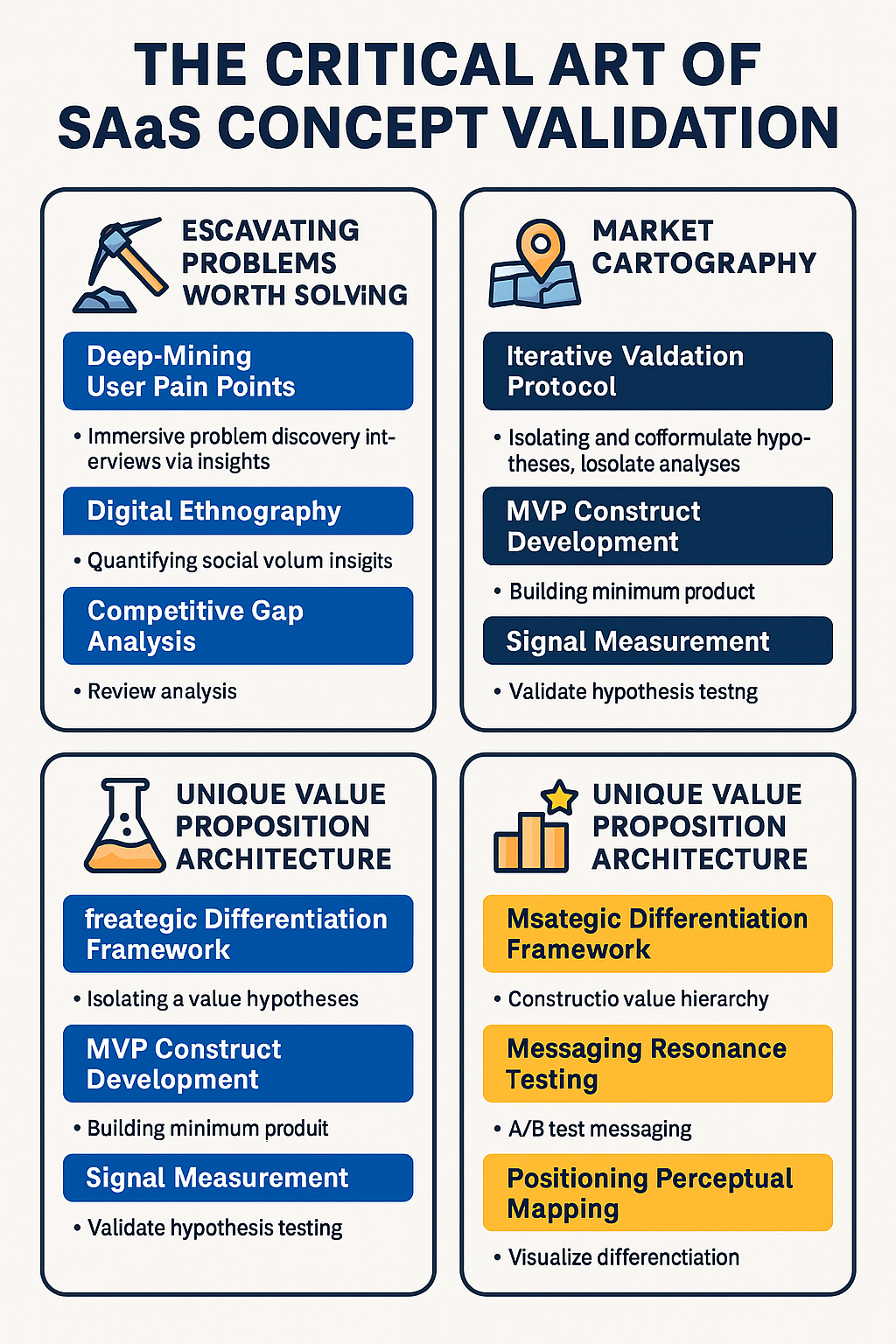
Your Unique Value Proposition
Your UVP answers a simple question: why should someone choose you over the alternative, including doing nothing?
How to develop it:
- Map customer priorities: Weight different aspects of the problem by pain intensity, frequency, and what people will actually pay to solve.
- Test your messaging: A/B test value proposition language through targeted ads or landing page variants. Find out which framing gets people to click.
- Know your position: Plot yourself against competitors on the axes that matter to customers. Where do you clearly win?
The 21-Day Validation Sprint
Here's a structured sprint that works in practice:
Week 1: Problem validation
- Days 1-2: Conduct 10+ customer discovery interviews
- Days 3-4: Analyze digital communities for pain point patterns
- Days 5-7: Synthesize findings into problem hypothesis statement
- Days 8-10: Complete competitive analysis matrix
- Days 11-12: Assess keyword demand and market sizing
- Days 13-14: Determine monetization potential and unit economics
- Days 15-17: Develop MVP or prototype
- Days 18-19: Conduct solution interviews or tests with target users
- Days 20-21: Analyze results and determine go/no-go decision
Why Validation Matters
Validation isn't just about avoiding wasted dev cycles. It shapes everything downstream:
- Investor conversations: evidence-based validation shows traction before you're asking for capital
- Product roadmap: knowing customer priorities makes feature sequencing obvious, not a debate
- Faster go-to-market: pre-validated messaging cuts time to your first real acquisition
- Team alignment: a clear understanding of the customer problem keeps engineering, marketing, and sales moving in the same direction
Next steps
A few principles worth holding onto:
- Problems before solutions: validate pain points before you start designing features
- Measure real signals: translate qualitative interviews into concrete, trackable metrics
- Let the data win: be willing to kill hypotheses that the evidence doesn't support, even the ones you like
- Document as you go: build a validation repository from day one; it becomes your strategic foundation